Showing posts with label Salmon. Show all posts

Friday, April 12, 2013

Palmnut Soup


This is a very delicious meal, which is very labour intensive, takes quite a while to prepare but is well worth the effort in my opinion. I am showing the óriginal'way of preparing it. Now we have canned palm soup base which eliminates the pounding of the palmnuts. This recipe makes a lot so feel free to adjust it to suit yourself.


Ingredients:
1 Olonka of palmnuts
1/2 Cowfeet (about 1 kilo)
2 lb Meat
1 lb Tripe
7 Round Crabs
2 Smoked Salmons
6 Onions
10 Tomatoes
6 Garden Eggs
15 kpakpo shito pepper
2 Ginger (thumb size)
6 Garlic cloves
Anis (pinch)
3 Maggi cubes


Start off by picking out any husks then washing the palmnuts. Just with plain water.


Place in a large pot and boil for about 45 minutes to an hour. You want it soft enought to fall off the nut when squeezed between you thumb and fore finger.


In the meantime wash the cowfeet, they are usaully cut for you at the market.


Wash and cut up your meet if it isn't already.


Cut and thoroughly wash the tripe. Most of the time it has a lot of sand in it so I prefer to run it under the tap. However you manage it, just get all the sand out.


Puree the ginger, garlic, anis and 1 onion. Pour this over the cowfeet, tripe and meat. Crumble 1 maggi cube over it and steam. I got a tough cut of meat so it cooked evenly with the feet. The tripe might get softer sooner.


Clean the salmon and set aside. This will be the very last thing to go in since it is very soft and we dont want it breaking apart in the soup.


If the crabs are fresh from the market and still alive, just pop them in the freezer for about 30 minutes. They simply go to sleep and die. This way they dont suffer and you dont get pinched by their claws.


To clean them, lift up the middle sail-shaped shell and using it as a handle, pull the whole shell off. This leaves a small mid section and the legs. Remove the pointed tips of the legs and wash thoroughly to get all the sand out. Rub off any mud that might be caked between the legs and body. Set them aside till later.

In a seperate pot, place the tomatoes, garden eggs, pepper and the rest of the onions. Add 2 cups of water and bring to a boil.

Pound the nuts in a mortar. If you are unfamiliar with the mortar, it is the deeper one used for pounding corn, groundnuts etc. You want to pound it until it looks fibrous and the black kernels are loose.


Pour it all out into a large bowl add about a litre of hot water. The water shouldn't be so hot that you cant put your hand into it. The heat from the water will help to seperate the edible part of the palmnut from the fibers and kernels. So using your hand, take the fiber part bit by bit and squeeze the liquid out and set aside. Then remove the kernels, shaking off the liquid back into the bowl. Keep doing this until you have mostly liquid with a few fibers in it.


Now place a colander over a pot or bowl and gently pour the palmnut mixture into it. You need to do this gently because there are some particles tha settle at the bottom and you dont want to pour them in. Leave a little of this liquid in the bottom with the black bits. Rinse out the colander and place over a different pot or bowl and gently repeat the process. Do this 3 or 4 times till you have no bits in the bottom of the pot/bowl.


Now pour it over the steaming meat and let it continue to cook over a high fire.


Blend the tomatoes and pepper and using a colander, add it to the big pot of goodness.

Skin and deseed the garden eggs and blend as well. This blends pretty smooth so doesnt need to pass through the colander.


Lastly, blend and add the onions. Add the remaining 2 cubes and some salt. Not too much though, since the soup will thicken. Check how tender the cowfeet and meat are. When they are soft enough, add the crabs. The cook really fast. They are ready when they turn red.


Add the salmon at this stage and reduce the heat. Stir carefully so you dont break the fish. Cook for 10 to 15 minutes longer and it is ready.


Serve with Omo tuo (rice balls), fufu, banku or eba.

If you are using the palm soup base, add the 1 litre of hot water (boiling this time) to it and using a laddle, stir it till it is smooth and seive it into the pot of steaming meat.

Tuesday, November 8, 2011

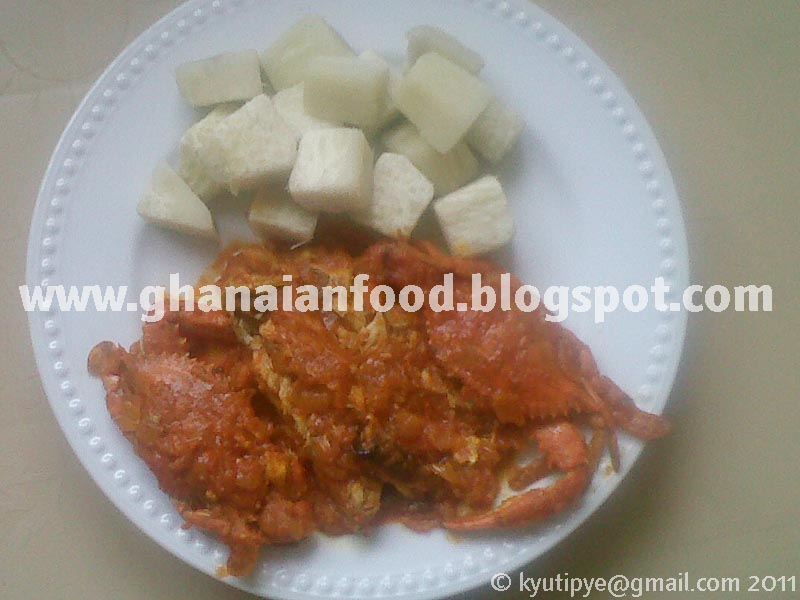
Crab Stew with Yam Cubes


My Mother-in-law brought me 5 tubers of Yam. I'm not a very big fan of yam, but my husband practically grew up on it.  A couple of days later we dropped her off at her aunt's place and the old lady was so pleased to see us, she gave six tubers. I had to laugh. Now its a race against the clock.
We were going to have Yam, no brainer that, but what to go with it. I had some flat crabs in the freezer as well as some smoked salmon. This is what I made ...

Ingredients:
5 medium crabs & 2 small ones
1/2 a large smoked Salmon
1 Tuber of Yam
2 medium Onions
10 medium Tomatoes
10 kpakpo shito (small green hot peppers)
2 Tablespoons Palm oil
1 Maggi cube
Salt

Wash and peel the yam, then cut it into 1 inch cubes.


Put the yam cubes in a pot. Add a bit os salt and sugar (about a teaspoonful of each) and enough water to cover it. Boil for about 20 minutes. Drain and keep in a food flask or  warmer.


Take the head off, remove the intestines (the fish is smoked with the inside intact to maintain it's shape). rinse it off gently. Break it into smaller pieces if you want.


Remove the little strip of shell that runs down the middle and pull out all the whispy/stringy (reproductive organs) parts. Remove the pointy segment at the tip of each leg as well as the shell bits covering the mouth area. these openings allow the flavour to penetrate as the food stews. Be sure to rub between the shell and legs to remove caked mud, then rinse thoroughly.


Chop the onions into bits ...


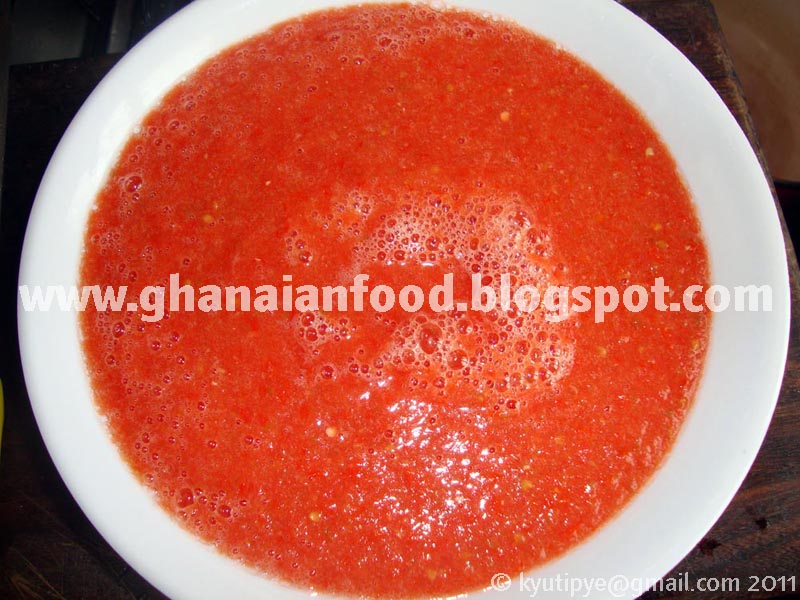
... and blend the tomatoes and pepper.


Heat the palmoil then add he onions. Fry untill the start getting soft and translucent.


Then add the blended tomatoes.


Simmer the gravy till it dries and almost begins to stick, then add the Maggi cube and salt, a little water and let it simmer some more.


Add the crabs, cover and lower the fire. let it simmer till the crabs turn red.


Add the Salmon and allow to simmer covered a few minutes longer to allow it to absorb the stew flavour.

Serve with the Yam cubes. Use your fingers for this feast. You are going to want to dig in!!!


Monday, June 21, 2010

Banku with Okro Soup


Ingredients:

1 pound of Beef
1/2 pound of Wele (cow skin)
1/2 medium sized Salmon
1 pound chopped Okro
1 mediun tomato
1 large Onion
10 - 15 peppers (kpakpo shito)
3 or 4 Garden Eggs
1/2 cup Palm Oil
Corn Dough
Cassava Dough
Salt

 
Chop the onion and cut and season the meat. Leave it to marinate for about 15 minutes.

 
Put the meat in a pot and and steam. Don't add any water, the meat will release it's juices. If the juices are drying up, but the meat is tough, add some water and keep on fire till it is tender enough for your taste.
 
Meanwhile you can blend the tomatoe and pepper. The mixture will come out looking more green than red since there is just one tomato.

 
Wash and cut the wele into 2 to 2 inch rolls and wash thoroughly. Dependin on where you got it and what state it was in, you may have to peel a black layer from the inside. You can have this done at the market. When you get it from a supermarket, this is already done. If it is very thick and hard, steam it in salted water with some bay leaves. Some people steam it with the meat, but I think it overwhealms the taste and smell of the meat.

 
If you haven't chopped the okro, now would be a good time to do it. I usually chop it as soon as I get back from the market, then freeze it till i need it. Keeping it in the fridge for a few days is alright but longer than that and it tends to become tough and stringy.

 
Cut the stalks off the Garden eggs then cut them lengthwise down the middle. Put them in a pot with enough water to cover them then bring to a boil. Cover and cook till the white fleshy part turns translucent (10-15 minutes). Seperate the flesh from the seeds and skin, add a little water and blend till smooth.


Heat the Palm oil in a pot and fry the onions.

 
Fry until they get soft but not long enough to start browning. Add the tomato/pepper pure and simmer till the liquid evaporates and it begins to fry.


While the sauce cooks, get your salmon ready. If is straight from the market, just split it down the middle and rinse out the insides (the inside are not removed from fish that is to be smoked) as well as the outside. Be sure to keep the skin. It is a personal favourite of mine although some people don't like it. If you are like me, you probably buy a batch and freeze, in which case just take out however much you want to use.

 
Add the salmon, meat, wele and garden egg puree. Strir gently for a minute or 2 then add a cup of water and lower the fire.

Put the chopped Okro in a pot, add 2 cups of water and bring to a boil. Add 1/4 teaspoon of baking/coking soda or a small lump of Kanwe (the local version easily got in the market). Keep stirring till it gets very slimey, that is what we are aiming for. The slimier it gets, the better.

 
After a while it will be bubbling up. When it threatens to boil over the edge of the pot, it is ready.

 
Add the okro to the main pot and stir it in.

 
Lower the fire some more and leave to simmer gently.

 
The rule I live by when making Banku is, 1 portion of Cassava dough to 2 portions of Corn Dough. So in this case, I used 1 pound of Cassava dough to 2 pounds of Corn dough. Cassava dough tends to be more lumpy and have in it, unmilled pieces of cassava, and so is prepared first. Place it in a container and add just enough water to cover it (about 1 1/2 cups for 1 pound). Now with clean hands, mix and mash up all the dough to form a watery paste. Pick out all the lumps and fibre that are in it. This may take a while (2-5 minutes). When all are removed, pour the mixture into a pot and repeat the process with the corn dough.

 
When this is done, add 1 teaspoon of salt and place on fire. Using a wooden spoon/spatula (there is a locally adapted spoon/spatula/paddle made especially for Banku and similar dishes), stir continuously until it starts to thicken. It needs the constant motion of stirring to keep it from turning lumpy prematurely.

 
As it progresses, it will start to gather at the bottom of the spoon and will need more and more force to stir it. Reduce the heat. Now use a dish cloth or towel to hold the pot in place, and still with the wooden spoon, start to knead it. Do this for about 5 minutes resting intermitently. Add 1 cup of waterand move the mass of soon-to-be banku until it is almost floating in the water. Use the wooden spoon to make a few holes in the mass so that the just added water can get all around. Increase the fire and cover.


As the water boils and evaporates, it is cooking the dough further. Turn it a few times during this process (About 5 Minutes). When the water is almost finished, turn down the heat and start kneading the banku again. Another 5 minutes should do it.

 
Use a small bowl or even the woodens poon itself to shape the banku into your prefered serving sizes. I personally use the plastic spoon that comes with rice cookers since it gives me the perfect size. I spoon out one portion into a small (margerine size) plastic bags and roll up the ends. It looks nice and is very convenient for serving, storing and reheating.

 
Serve it with the Okro soup. Interestingly, Banku can be eaten with almost any soups and stews.
Just like any food, there are many variations of this dish. I would love to hear and try them. Let me know how you prepare and eat your Banku and Okro soup.

Like

Related Posts Plugin for WordPress, Blogger...